Conversation with Ferenc Jordán, Network Research Biologist
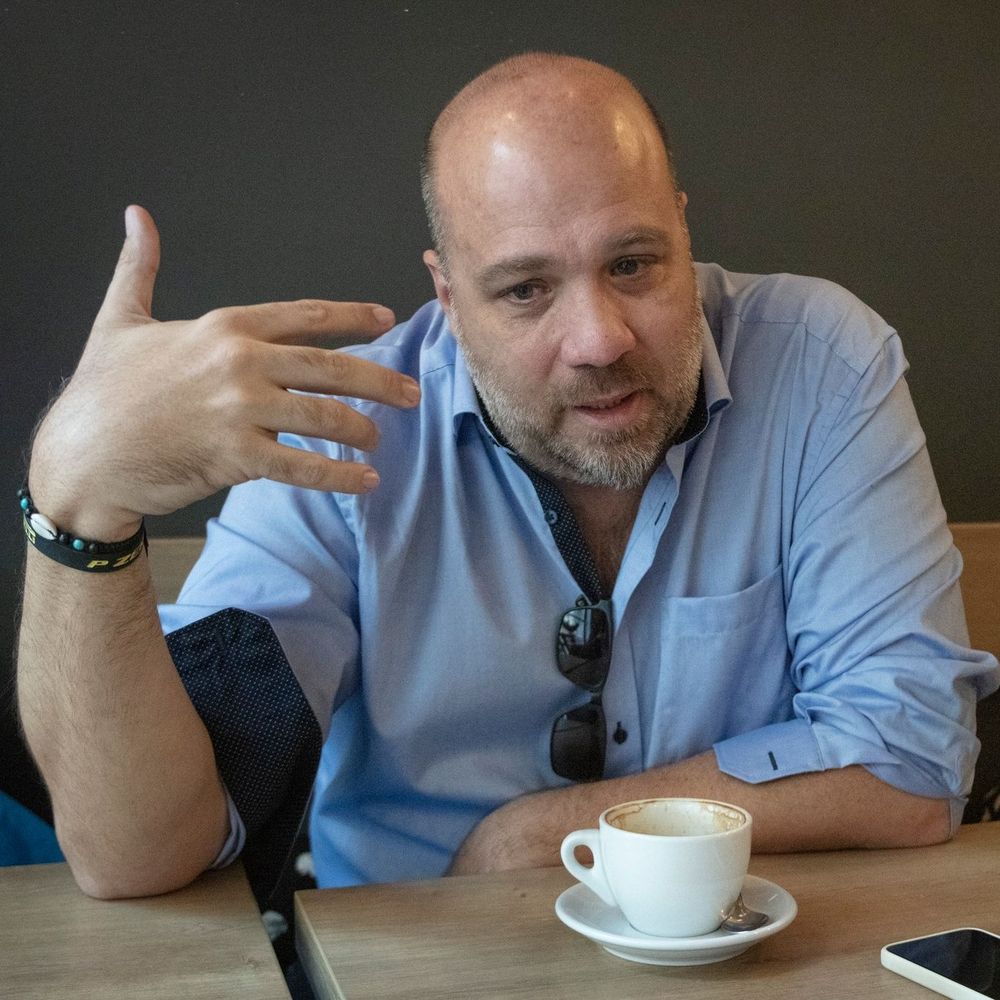
Ferenc Jordán is a network researcher biologist and systems ecologist. He has been living in Vienna for some time, but works at the University of Parma, commuting by train because he sold his car to reduce his ecological footprint.
He was the head of the Balaton Limnological Research Institute and a fierce opponent of encircling the lake with concrete, the senseless destruction of reed beds, and the environmental degradation caused by the construction of luxury properties. After a year and a half, he was dismissed. He no longer plans his professional career and future in Hungary. | Interview by Andrea Nichs – photo: Vanda Bujnovszky
– What research are you currently involved in at Parma?
In a Norwegian-Italian cooperation, we are examining how the ecology of the Barents Sea has changed due to warming. Some Atlantic species have appeared, completely disrupting the ecosystem.
The Norwegians send the data, and we calculate how much the structure of the community living in the sea has changed, how this affects the functioning of the ecosystem, and based on this, we will make recommendations for fishing.
I am working on this project for three years, we will finish soon, and then I will continue my research work in Cluj-Napoca.
– In the past of most environmentalists, there is some rural life next to a forest, an idyllic childhood. Was this the case for you as well?
I am from Budapest and we didn’t have a garden, but I spent most of my summers around Lake Balaton. I was outside all day, looking for snails, bird feathers, observing nature, everything interested me. Durrell and Attenborough were like gods to me.
– You earned your doctorate in genetics at university, what prompted the change?
As a biologist, I was interested in everything, from ethology to biochemistry, ecology, or genetics. At that time, the doctoral school in genetics at ELTE was of superb quality, so I went there and I don’t regret it. But if you are interested in everything, you eventually reach the fundamental questions of biology: why do we age, why are we multicellular, how reliable or stable is a biological system, and so on. From there, it’s just a step to the questions of biological and ecological networks, which seemed like a very interesting field.
I was fascinated by the first collections of food webs and their mathematical analysis. Joel Cohen, a researcher from New York, had a book full of data, which was a big deal at the time!
– The issue of global warming has become a repeatedly discussed topic. The Norwegian-Italian research you are working on is essentially examining one of its effects. Perhaps because we have become accustomed to the idea, we no longer really consider its significance, even though a survey indicates that 2023 was globally the warmest year since measurements began.
This means that for more than half of the year, we exceeded the average temperature for those days by at least 1.5 degrees compared to pre-industrial levels. What does all this mean and why is the industrial revolution the reference point?
I am generally very skeptical about major agreements and treaties, despite the fact that it is extremely important for the peoples of the earth to collectively say stop to overconsumption and take action.
I consider most of the measures to be mere window dressing, and their professional content is quite weak in my opinion. Numbers pulled out of thin air and unrealistic goals abound, mainly serving to ease our conscience.
The question of the reference point arises in terms of what we compare to and what state we want to preserve. It could be the period before the emergence of humans, the era before modern agriculture or the industrial revolution, or even our childhood. It depends on what each person envisions. These are not clarified either.
It can also be said that activities related to the protection of the biosphere are becoming increasingly bureaucratic, reflecting more diplomatic, legal, and economic thinking, moving away from scientific thought. Many ecologists are proud of this because we finally “speak the same language” as decision-makers, but in the process, we sacrifice hard-earned knowledge.
– For decades, natural scientists have been “saying their piece,” but they seem to be losing out, for example, to social sciences or tourism.
Yes, natural scientists have been saying roughly the same thing for 60-70 years. In fact, Humboldt already spoke about nature conservation in 1799: as soon as he set foot in South America, he saw that the Spanish colonizers had certainly left their mark. Recently, it seems to have become a mass phenomenon, a movement, that people are beginning to take responsibility.
The problem arises when things reach the level of decision-making. There we encounter hard lobbying. It is clear that to protect the biosphere, almost every process should be directed in the opposite direction.
– You wrote about this in your book “The End of Man, the Chance of Nature.” Quite a dramatic title…
Serious researchers say that humanity, or more precisely our current culture, may only have 50-100 years left. So the situation is very serious.
If the situation is this dire, then I think one should either write nothing or, if they do write, it should be provocative and thought-provoking. That was the goal of the book: to shake up the readers.
There are many extreme ideas in it, but I didn’t want to write another book about how large our carbon footprint is or how there are fewer and fewer butterflies. Instead, I dug deep and asked questions: who do we think we are on this planet, how do we behave, what rules do we live by, why are we unable to solve a series of problems?
Ecosystems are fantastically adaptable, but human activity often doesn’t allow time for a response, we bind nature, we don’t let it function. Yet a happy society can only be imagined alongside a healthy nature. We don’t even realize how much we owe to the ecological processes around us: clean water, clean air, pollinating insects.
Ecology is the science of coexistence, and we would be part of the system, but we are increasingly distancing ourselves, opting out of the game, wanting to become directors instead of main actors.
Why do we think we can and should consume and reproduce without restraint?
We devour everything around us, using up resources equivalent to two planets annually. To use a prosaic analogy (and this is not my own example), we drink in the pub as long as we have money. Then, of course, we can drink on credit, but sooner or later, it will be collected harshly. In short, we are playing with our children’s future.
The book is somewhat moralizing, philosophical, supported by a wealth of scientific data. I often say that the genre of my book is a volcanic eruption.
– Earlier, you touched on the issue of overpopulation in a sentence. How serious is the problem? Is there a possibility for self-correction? You have three children yourself, so you’ve probably thought about this quite a bit.
Transforming social norms could be a solution. For example, it’s okay if someone chooses not to have children. Of course, I’m not saying that the goal is for humanity to become extinct. Someone can have multiple children, but we should move towards responsible family planning and quality child-rearing. Women shouldn’t have children just because our culture or society expects it of them. The focus should be on how many children a family can raise lovingly and to a high standard.
In the book, I talk a lot about how inflexible we are, living by rules that were valid in the past but no longer hold today. In the past, hunters and warriors were needed, and child mortality was high. This is no longer the case.
Our culture could help us get out of the problem, but it also freezes us, preventing us from adapting to the world we’ve created. Everything is changing at a crazy pace, yet we are incredibly rigid. We came up with something a hundred or a thousand years ago and stick to it. In contrast, natural systems are very adaptive.
Let me give you a very simple example: water scarcity is becoming more significant, drinking water is depleting, yet we flush toilets with crystal-clear water. Why? You don’t need to be a brain surgeon to see how unreasonable this is.
There are some positive examples: the handling of the ozone layer is perhaps the greatest success story. Why not declare that from tomorrow morning at 8, not a gram of green space can be destroyed? We should be focusing on rewilding areas because nature doesn’t have enough space, it’s confined, and can’t function properly. We devour forests, fields, and exhaust our environment.
Nature’s response to all this would be relatively simple. Suppose rabbits start to reproduce, which they are quite good at. The first regulation possibility is that their food supply runs out, the second is that predators keep them in check, the third is that their habitat drastically decreases and then disappears, the fourth is that a parasite finds them, and finally, they start fighting among themselves.
Humans have roughly solved the first three: there’s plenty of food, we’ve elegantly eradicated most of our predators, and we’ve inhabited the entire planet. Epidemics can still be dangerous, although they don’t necessarily significantly reduce our eight billion population. So, wars and local conflicts over water and food remain.
From an ecological perspective, this is the only control factor we can currently rely on. It’s a sensitive topic, with much debate about how many people the Earth can support. I think the limit is one to one and a half billion, maybe even that’s too much.
It’s not just about how much food is needed or how much waste we produce, but also that, for example, modern agricultural production requires destroying half of the natural environment. This is also part of our ecological footprint, as is global trade and the mass production of countless, completely unnecessary convenience items.
Someone who uses an electric leaf blower to move leaves because they’re too lazy to sweep won’t be “green” just because they drink from a paper straw afterward. So, a much more complex approach is needed.
It is clear that consumption must be dramatically and immediately reduced, including global trade. But the cause of overconsumption is not just luxury yachts and private jets, but also modern agriculture serving the masses, which is ravaging the planet.
– Well, that sounds quite dystopian…
Yes, I am pessimistic too. There is no international dialogue, no cooperation.
– What will happen to us, say, in fifty years?
Water scarcity will be a huge problem. There will be many local skirmishes and conflicts, air travel will be restricted, and transportation in general will become very expensive. People will return to the practice – which they could already do wisely now, but we will do it out of necessity and suffering – of going to the neighboring village for tomatoes instead of buying Moroccan tomatoes at the supermarket.
We still have a choice now, but then it will be a necessity. Now it’s a matter of choice whether I get in the car or take the train, and so on. But instead of thinking, we are heading straight into a wall, and we will again return to the question of who will be able to adapt and who will not. If you like, some control mechanisms will be reactivated.
– Today, more and more people are choosing to move out of cities. Could this be a solution?
What if millions of us left the cities? Is it good for nature when two million people from Budapest or ten million from New York say they are fed up with city life and go to the streamside to dig? If we spread the masses evenly across the Earth, nature would disappear. Globally, this is not a solution.
In any case, every attempt is important, we encounter exciting patterns, and people often follow patterns rather than laws. But for now, it’s a drop in the ocean. A global lifestyle and philosophy change could bring some kind of solution.
– The picture is not very positive, how do you prepare your children for this?
I have two older sons, twenty and twenty-two years old, and a nine-year-old daughter. We talk a lot about these things, and I always give them the same advice: be incredibly flexible, learn languages, don’t get attached to properties or objects, try to carry everything of value in their minds (and hearts). Then they will be perfect adaptation machines.
– During interviews, lectures, and discussions, don’t you get tired of repeating the same fifteen to twenty important thoughts?
I enjoy talking about this, but if something were to happen, I would be even more enthusiastic. In fact, I most enjoy talking to young people who don’t think green.
I also like to provoke environmentalists, I often talk about how invasive species are not necessarily enemies, sometimes they can actually provide solutions to problems because they can help an ecosystem adapt. I didn’t come up with this; the biosphere has been working this way for four billion years: during mass extinctions, broad-tolerance generalists keep ecosystems alive while a number of narrow-tolerance specialist species go extinct.
For conservationists, this is unacceptable; we are not happy about either extinctions or the appearance of new species.
But that’s how nature works, and today we are living in a period of mass extinction. Of course, invasive species can cause many problems, but there will be more and more situations where they also bring solutions. Nature doesn’t care which species is endemic (native, indigenous); what matters is that the system remains functional. We know nothing better than nature.
Let nature operate; that will be best. Let’s not interfere, because nine times out of ten, it turns out we’ve caused trouble. Everyone means well, but no one can predict the impact in advance, and we can’t fully monitor what happened afterward. My true hero is a Swedish billionaire who bought a vast area of the Amazon rainforest and does nothing with it. He doesn’t even go there; he just lets it grow and lets happen what needs to happen. You can’t do better than that in the name of conservation.
– What is worth doing then, how do you do it?
There is a difference between ego and eco, right? We need to see if what we do for ourselves is also good for nature. When a million of us go hiking in the Pilis on a sunny weekend, littering, flooding, polluting, trampling it, we are not thinking in terms of partnership. The only thing that matters is that hiking is good because I want to hear birdsong, I want to breathe clean air, I want to see green, and then I leave 70 tons of trash behind.
I avoid this by not going hiking when everyone else does. If you avoid the crowd, you’re already doing something good. Every biologist dreams of watching lions in the Serengeti National Park. There are three thousand tourists for every three lions, so there’s no need to go. It’s terrifying that tours are organized to Antarctica, with ships lining up while one group finishes taking selfies. Perhaps we are now finishing off the last roughly untouched area. But a bored official, when on vacation, will do anything their wallet allows.
However, I don’t want to discourage anyone; individuals can do a lot for their environment, but we need to rethink cultural and social dogmas and adapt to the changed situation. Planting trees is also important, for example, the intention is good, but reforestation can be more effective if someone ensures that the area can still be a forest in a hundred years. Of course, it’s much better to plant a tree than to pave over a driveway.
Source: Vulkán Literary Magazine