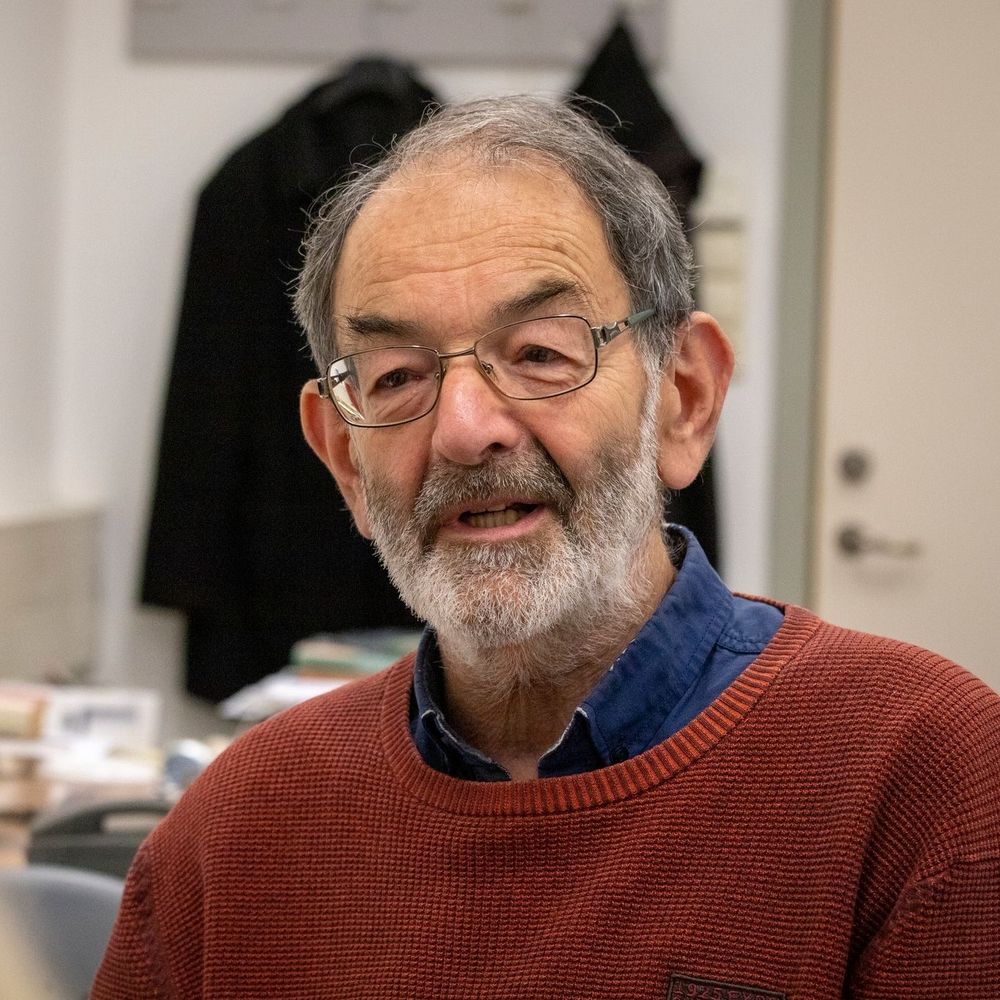
Interview with András Lányi
“the competitiveness myth is outdated” – a conversation with Andrea Nichs
Artist, philosopher, associate professor, founder of the Master’s Department of Human Ecology at ELTE TáTK. The interview with her is part of a series of interviews with renowned scholars including Ferenc Jordán, András Takács-Sánta, András Szöllősi-Nagy, Alexandra Köves, Réka Aszalós (https://vulkanfolyoirat.hu/10-millio-fa/) – reflected with us on the future we face in the midst of the ecological crisis.
*
– In 2000, he tied himself to the Gresham Palace, which may have seemed an unrealistic idea, but it was a powerful gesture. So much so, that it prompted him to organise a protest at that site in 2022 over the 10 million Wood for Firewood/Deforestation Ordinance. Do you know if you inspired others with this action?
I have written over 20 books, but none of them had the impact of this action, when I chained myself to the tree on my bike and sat down to read. It was a conscious gesture of communication, of course. At that time, the Conservation Association was being formed, with the slogan of making politics out of environmental protection.
We realised that whether we were protecting animals or forests, it always came up against some political will. We needed a campaign to raise awareness. Although there were more important, more endangered groups of trees in Hungary, this one was practically on the main square of the country, at the Chain Bridge, so it was a very conscious choice.
The reason they wanted to cut down the trees there was because they were blocking the view from the hotel windows. We didn’t think it would be done for our sake, although some were eventually left. At the moment, a dear old friend of mine, Ágoston Ébert, is about to chain himself to a tree on the banks of the River Roma, in Piroska Rozgonyi Street, because since spring there has been a fight to save a centuries-old chestnut tree, which is being decimated on the grounds that the trees are diseased.
But when trees are sick depends on a rubber law that says, for example, that a tree that is presumed to fall in 180km/h winds can be legally removed. But when has there ever been such wind in Budapest? Winds of 172km/h were measured once in the last millennium.
The other method of investigation is visual observation. This was developed by Dezső Radó, the greatest defender of Budapest’s trees and parks in the 1980s and 1990s. The method examines the root system, the foliage, the degree of neglect, disease and desiccation. It’s professional, but when it’s scored by visual inspection, not much follows.
I’ve found that when you want to build something somewhere, the visual inspection, the expert’s opinion, is usually that all the trees in the way of the construction are diseased. Unfortunately, this is also the case with the highways along the Balaton, where trees are being cut down one by one. Of course, taking care of a tree line is always more troublesome than not taking care of it.
– Would you chain yourself there now?
No, I already encourage my students to do so.
– How did you go from writer-philosopher-filmmaker to human ecologist? And what does the master’s degree you founded and where you still teach do?
The course is basically social science-oriented, with some science subjects. We are dealing with the social causes and consequences of the ecological crisis.
The question is, of course, really how humans work. And this is a question of philosophy, ethics, sociology, political philosophy, and I have been dealing with these things for quite some time. In fact, I was interested in history and literature, and I was interested in the Ligett, and just last week I published a volume of essays on history and literary history, Farewell to the Nineteenth Century.
I can say that I didn’t want to deal with the ecological crisis, the ecological crisis started to deal with me.The Bős-Nagymaros dam was the first case in the 1980s, when I got involved in the protest wave thanks to my friend Gábor Karátsony. Suddenly I found myself in the middle of the debates where arguments were needed, so I started reading, studying, thinking and arguing.
– What do you think about the role of intellectuals today? It’s as if the discourse has stuck to the more sociological dominant themes of the 1980s – the Roma issue, poverty – and the ecological crisis has barely entered the dialogue.
There are three major thematic groups that intellectuals jump on: the nationalist intellectual on the question of national identity and historical grievances, the liberal intellectual on individual liberties and free market competition, the leftist or socialist intellectual on social inequality, injustice, disadvantaged minority groups. What does not fit into these three bags, the intellectuals do not react to. In the meantime, a fourth, big problem has arisen, which is that the vital natural systems of provision have reached the limits of their capacity and the resources with which nature provides for the cycle of life have been severely depleted.
We should rethink our basic concepts: what is the good of existence, what does my freedom and human rights entitle me to, do I want economic growth, are development and growth the same concept? These are fundamental questions of worldview which should be addressed by intellectuals above all. It is an intellectual work that we have not done, and we wonder why the country is being rapidly concreted over, the land is being destroyed, biodiversity is in ruins.
You would not believe that in the protected Pilis park forest, a hundred metres from inhabited areas, a villa is being built in the middle of the forest, revolving on duck legs, while not far away homeless people are building their little mini cities. I can understand the latter much better anyway, but the point is that the forest boundary is being pushed back.
How can it happen that everything is built on and the law is not violated? Nothing actually protects the green spaces in Budapest, or the countryside. They operate with tree plantations instead of forests, but planting trees of the same species next to each other does not make it a forest! A forest is an ecosystem with old dead trees, young shoots, lots of undergrowth, bushes and animals. It takes about 300 years for a real mature forest to develop. Our most beautiful forests in Transdanubia are used as biomass for thermal power plants in Ajka and Pécs. In an earlier interview, Ferenc Jordán said that biologists and ecologists have spoken and written enough, now it is the turn of social scientists and philosophers to nuance the discourse.
Natural scientists are not familiar with the literature of philosophy and the social sciences, and we are not familiar with theirs. It was mostly philosophers, writers, painters and film directors, both in the world and in this country, who began to worry about the state of the environment and began to seek explanations for how late modern industrial society had become so depraved that it was cutting down the trees and destroying the very conditions of its existence. In the 1990s, we started to say this, and few naturalists agreed with us. I think it was biologists who started worrying and addressing this too late.
– In his essay To Hope, he writes that the future of nature is not a matter of natural science. He also offers suggestions for solutions, saying he is confident that, despite the bleak picture, there is a way to make a difference.
We must get away from asking: what can I do?alone, what can a small country do on its own? Of all the factors of the ecological crisis, the climate crisis is the only one that is a global issue, so the solution seems more remote. But we can make a difference in terms of water pollution, soil degradation, biodiversity collapse.
Who is stopping us in Hungary from switching to water-retentive farming, who is stopping us from protecting our forests, greening our settlements, switching to sustainable forms of agriculture, protecting vital pollinating insects from the effects of poisons called pesticides?
But if no one, then it is clear that every country, indeed every municipality, could in principle protect its environment.
The reason climate change has such a good press is that we cannot do much about it on our own, it would really require international cooperation, so we feel absolved of responsibility. What we can still do is conscious family planning, i.e. a gradual reduction in the current human population, a reduction in anthropogenic material and energy flows, the spread of a circular economy, a shift to environmentally friendly, small-scale, gentle technologies, decentralisation of the economy, a radical reduction in long-distance trade and the (re)discovery of opportunities for a good human life that do not depend on the consumption of material goods. Above all, this would mean breaking the economic and cultural monopoly of global networks and allowing local communities to assert their will, to reclaim the means of real self-determination.
– Isn’t this essentially a political issue?
Not only that. The political, economic, scientific, cultural, and media elite that derives its power from the existing world order has no interest in changing the forms of governance, the idea of prosperity that prevails today. It promises a multitude of material goods and services as compensation for failing to provide meaningful work, social dignity, meaningful human relationships and a healthy, healthy environment for the majority. Work a lot, earn a lot, eat more, travel elsewhere, have fun and buy our services, and you will be beautiful and successful.
– Not a very promising prospect. Where do you get your optimism from?
The world has been a world for a long time, the system in place has survived because it was strong, but the small and weak have still been able to change their fate. Maybe the inflexible, ossified, self-surviving system will collapse on its own, or maybe the new will defeat the old.
Let’s know the technologies that could be used today to replace brutal, large-scale, energy-wasting, polluting technologies with environmentally friendly, locally adapted, small-scale, gentle processes. The first country to get off this merry-go-round, which we call a global economic race, will do well.
The particular competitiveness myth that our beloved prime minister is now trying to shove down our throats is outdated thinking.In a race in which we have to compete with the cheapest slave labour in Asia and Africa and the most advanced high-tech in the US, we can only be losers. But if we manage according to our own capabilities and reduce our dependence on the global economy, we will create a lot of jobs, diversify our employment structure, not have to ship as much and not be so dependent on distant partners. Of course, those who are billionaires from exactly what works now would be badly off, and they have the tools to influence public opinion.
– In the previously quoted writing, he also talks about how we are the first generation to live in the knowledge of impending disaster, and probably the last to live in the knowledge of impending disaster.g can have a decisive influence on its outcome. Why do you think so?
Every generation starts from a worse position. We are making decisions that will define generations or forever, radically limiting the life chances of those who come after us. They can only choose from the stock we have left them in the pantry. What we have consumed from them is consumed. Our responsibility is therefore unprecedented. It is common to talk about climate change anxiety, but young people should be afraid, not anxious.
The way to cure climate change anxiety is to find the cause. If you know what you are afraid of, you can defend against it, and then you have moved towards constructive action. This is true systemic change, not in the power sense of the word. Responsible participation in the management of my own destiny.
Of course, no one should be expected to spend their time solving global or national problems, that is the job of politicians. Politics is inescapable, but regardless, everyone can find plenty to do in their own lives, and if they look around, perhaps even find partners with whom they can work together to achieve something more: a better quality of life for themselves and their fellow human beings. I note that this is also how politics begins.