We Need Each Other
How winding was the road that led to the 10 Million Trees?
In the summer of 2019, there were massive forest and bushfires worldwide – in Siberia, the Amazon, and Australia. This triggered immense climate anxiety in me, and I couldn’t sleep. I have two daughters, and I could only think about how they have no future. In mid-August, I saw a Facebook post about a local 10 Million Trees group being formed in the 22nd district, where I live. I wrote to the group’s representative, expressing my willingness to help with the organization if possible. It was possible. Time has shown: active engagement alleviates anxiety, but it soon became clear that I gained much, much more!
How do you remember the beginnings?
We met in the garden of Franciska Hervai (the chief coordinator of 10 Million Trees) at the end of August, quite by chance, as she also lives in the 22nd district. There were four of us. Four eager civilians, four strangers. We sat down to brainstorm and decided that as a first step, we should announce meetings at the cultural center’s café. We did it. Then again. Each time, more and more people joined. A core group formed, who then actively participated in organizing and planting. Together, we set the goal of planting trees in the local Kresz Park on Life Day, among other things. At the beginning, we didn’t even know where to start: where to buy trees, whether we needed permission from the municipality, or how to raise funds, recruit volunteers, and, in general, how to plant trees professionally. Then, during many “tree-meetings,” everything fell into place like a dream. The experts from 10 Million Trees provided the knowledge. A local green organization, Green Future, helped with fundraising. For this first planting alone, we raised over 300,000 HUF from individual donations! On the day of planting, approximately 80 (!) volunteers showed up, the district TV was there, and famous actors came to promote the program! And we had bright, sunny weather on November 9th! It was such a miracle that we couldn’t believe it! Incidentally, the first funds came from my own daughters: they always received small amounts as gifts from their grandparents for name days and birthdays, and seeing what I was striving for, they suddenly handed me twenty thousand forints. They were 8 and 5 years old at the time. So, of course, it was only natural that they named one of the trees planted in Kresz Park: János celebrates his fourth birthday in the fall.
The first occasion was followed by increasingly serious plantings, if I understand correctly.
Yes, although COVID caused some setbacks in the plantings, we kept in touch with the team online and, of course, tended to and watered our trees. Meanwhile, we dreamed of how great it would be to green more with a bit more money. Our wish was granted at the end of 2020 when, out of the blue, we received an inquiry from The Church of Jesus Christ of Latter-day Saints, expressing their desire to collaborate with us to plant 700 trees in the district within a year. I think none of us, except Franciska, believed we could do it. But we did it!
Why did you decide to transition from a volunteer to an employee at the Foundation?
I worked as a structural engineer at a small company specializing in the design of prefabricated reinforced concrete structures, in a comfortable office, and later from home with flexible hours, but… honestly, it was mostly just a job, a way to earn money. Meanwhile, I was internally torn by the duality of designing battery factory halls while environmental protection is one of my core principles. I felt strongly that I needed to change and engage in something that truly reflects my values. And then – almost as if by request, as always – the opportunity came: a 10 Million Trees project on an even larger scale than before, for which the organization needed a full-time person.
Did your family support you in this?
My husband fully supported my decision and continues to do so, partly because he sees that this is my calling, that I am finally doing what I love, and partly because he agrees with the importance of the goal. However, I would be lying if I said there was nothing that bothered him. For example, sometimes our garden is filled with over a hundred trees, stakes, bags of fertilizer, and piles of debris, or that he has to pick up the kids from school more often if I don’t make it back in time from a planting. And, of course, I had an engineering salary, which I stepped back from to a foundation level. My brother offered to supplement my monthly salary, and although I didn’t take him up on it, knowing that he and my parents support me is a comforting and reassuring feeling. Our daughters, of course, see that I’ve worked even more in the past six months than when I was volunteering alongside a six-hour job, and so I’ve spent less time with them. This naturally causes some guilt, but I believe it’s worth it even from their perspective. Firstly, because they receive a good example of authentic behavior: they see that we truly act on what we believe in and act according to our convictions. It’s also worth noting that although I may be more tired, I have become much more satisfied, balanced, and cheerful than before. This summer, “only” watering is left, so I plan to make up for the lost time. Besides, I feel they are proud of their mother.
The joint project with K&H – the “Cooling Groves” – was implemented in the courtyards of 100 educational institutions nationwide. How did you manage to handle this enormous undertaking?
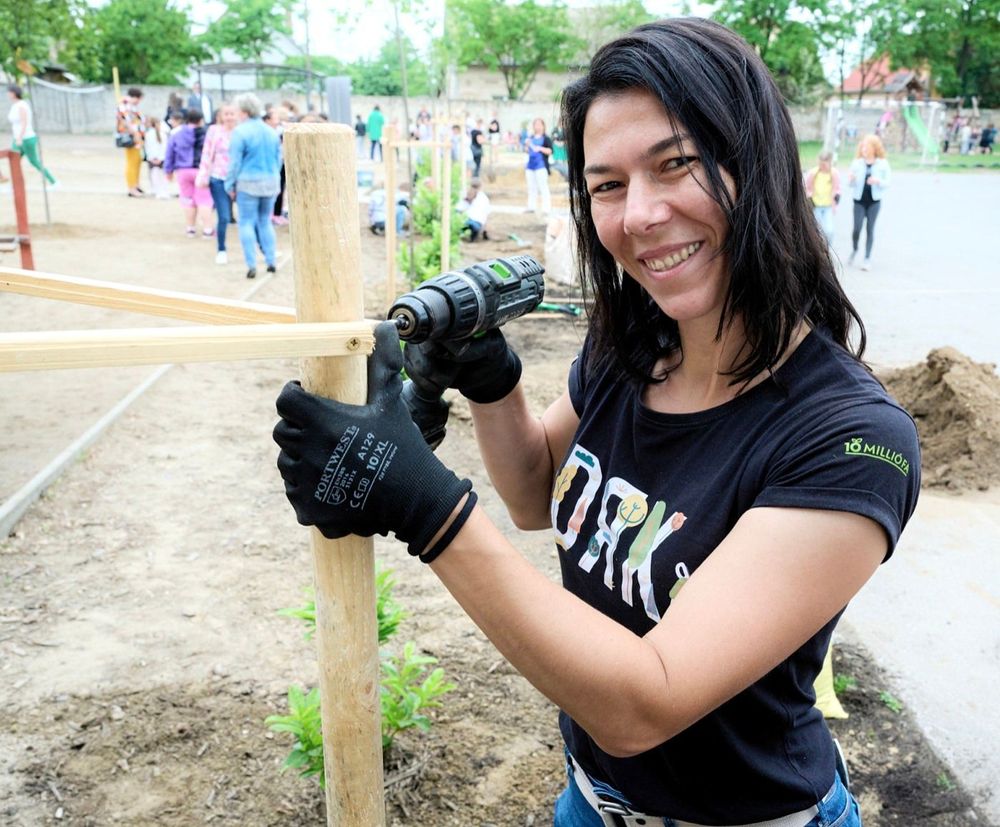
With the help of gigantic Excel spreadsheets. But I didn’t do it alone; it was a team effort, and that was the key. Another crucial factor was that Franciska was there to “hold my hand” throughout, guiding and encouraging me. We started by asking representatives of local groups who would be interested in participating in this project. Fifteen people signed up as organizers, plus an additional 3-4 gardeners joined in. We divided the winning locations among ourselves, and I tried to coordinate the whole thing. I wrote a know-how document detailing the project’s specifics, and following this guidance, the representatives contacted the institutions, assessed the sites, and began organizing. We mostly ordered the necessary trees and other items centrally, then came the logistics, and in most cases, Hervai Lőrinc, our all-round ace, handled the deliveries. But there were times when I delivered the trees or loaded the car for the next day’s delivery. Coordinating the details of the planting, organizing the workforce, giving presentations to the children, conducting the planting, etc., were again the responsibilities of the 10 Million Trees representatives. Finally, I handled the administration and photo uploads. A bookkeeper helped navigate the jungle of invoices. Additionally, I organized one or two plantings per week at my own sites. I also had four overnight stays when I had to travel far. During these times, the invited gardener colleagues almost became friends. The first planting took place at a school in Budakalász on November 30, 2022, and we completed the project by the deadline on May 31. We planted 555 trees and 1,110 shrubs in educational institutions at 100 locations across the country. It is clear that there is a huge demand for more: over 480 institutions applied for the K&H grant! We hope there will be a continuation. We planted for children with children. That’s why this project became very important and dear to me. Thousands of kids participated in the Cooling Groves plantings, from toddlers to high schoolers, to whom we could explain and show the why and how of tree planting, leaving them with a positive impression, a good experience, and some knowledge on the subject. Not to mention, it brought me immense joy to work with them, teaching and learning from them, hoping that we made their future better with a few planted trees and thoughts. I had wonderful experiences during the plantings: there were times when children planted to the sound of flutes at a music school, they often placed messages next to the trees, and there was almost always singing, choirs, and recitations. They were enthusiastic, helpful, and skillful. It was evident that this was a special occasion for them as well.
What new competencies have you acquired during your time with 10 Million Trees?
For example, I was forced to take on driving a flatbed truck, something I never thought I would have to do. But we were left without a driver, and we had to go. The day before, we tried it out; I drove a few laps in a parking lot under supervision, and then the next day we set off for Nyíregyháza. We made it there. All for the goal! Another significant development for me, which I am very pleased about, is that I used to have quite strong stage fright when I had to speak in front of more than two people. I think all my acquaintances can attest to this with a smile. But over three years, I managed to shed this as well, and I now speak calmly in front of groups at various events. How well I speak is another question, but there’s always room for improvement.
What would you highlight about your work with 10 Million Trees?
The importance, strength, responsibility, and joy of the community. You can’t plant 10 million trees, tackle the climate crisis, or save the world alone. But you don’t have to; it’s a collective goal. Behind each of these larger projects is the work of hundreds or even thousands of people. We need each other, and as this story precisely proves: even if it seems impossible at first, together we can succeed! Not to mention the amazing, potentially lifelong friendships that are formed in 10 Million Trees, the many experiences, memories, and the good feelings! Personally, I am very happy to be a part of it.
Laura Balázs