Interview with network research biologist Ferenc Jordán
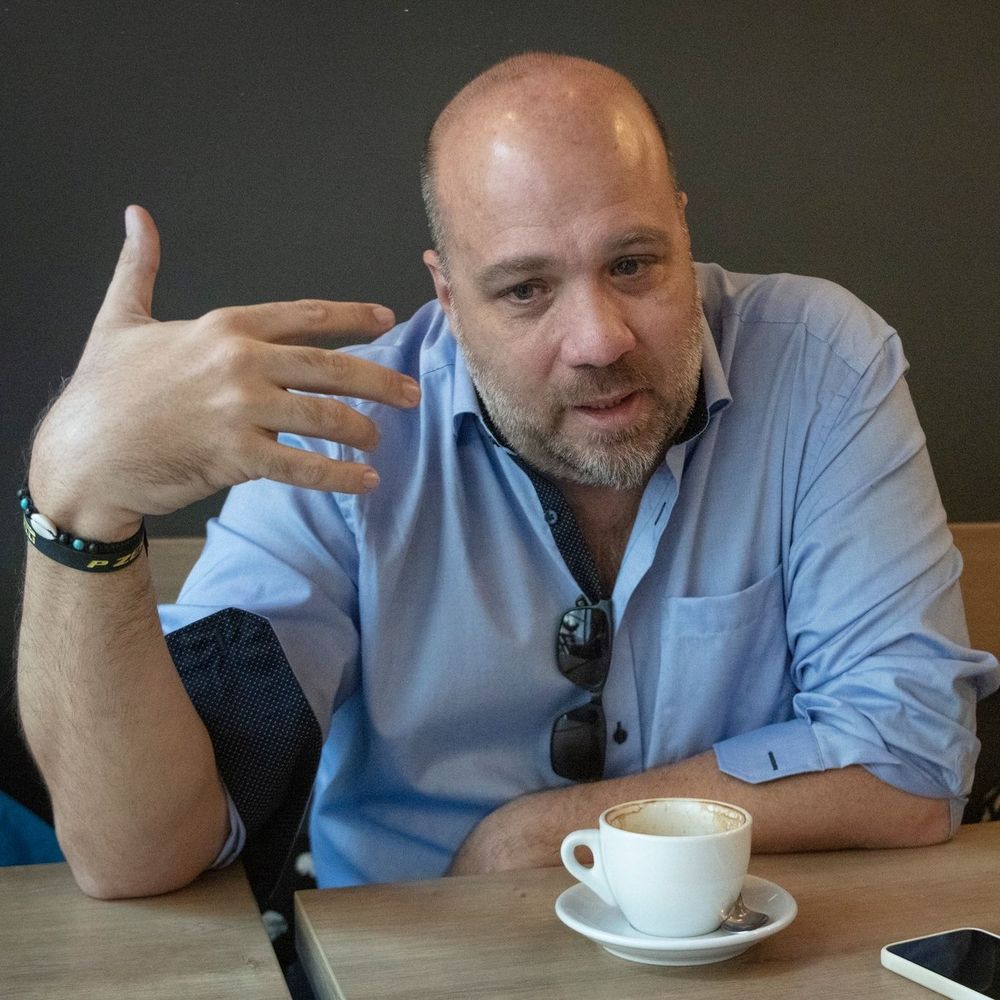
Ferenc Jordán is a network research biologist and systems ecologist.
Ferenc Jordán is a network biologist and systems ecologist. He has been living in Vienna for some time, but works at the University of Parma, where he travels by train because he has sold his car to reduce his ecological footprint.
He was the head of the Limnological Research Institute of Lake Balaton, a militant opponent of the concrete construction around the lake, the senseless destruction of reed beds and the destruction of nature by the construction of luxury villas. He was replaced after a year and a half. He no longer plans his professional career and future at home. || Interview with Andrea Nichs – photo by Vanda Bujnovszky
– What kind of research are you involved in now in Parma?
In a Norwegian-Italian collaboration, we are investigating how the ecology of the Barents Sea has changed as a result of warming. Some Atlantic species have appeared, completely disrupting the ecosystem.
The Norwegians will send us the data and we will calculate how much the community structure in the sea has changed, how the ecosystem is functioning differently as a result, and make recommendations for fisheries.I’ve been working on this project for three years, we’ll finish soon and then I’ll continue my research in Cluj-Napoca.
– Most environmentalists have a history of living in the countryside near the forest, an idyllic childhood. Was that the case for you as well?
I am from Pest and we didn’t have a garden, but I spent most of my summers around Lake Balaton. I was outside all day, looking for snails, bird feathers, watching nature, everything interested me. Durrell and Attenborough were the two gods for me.
– You did your PhD in genetics at university, what was the reason for the change?
As a biologist, I was interested in everything, from ethology to biochemistry, ecology and genetics. At that time, the doctoral school in genetics at ELTE was of super high quality, so I went there and I don’t regret it. But, if you are interested in everything, after a while you get to the basic questions of biology: why we age, why we are multicellular, how reliable or stable a biological system is, and so on. From there, it was a step into the question of biological, ecological networks, and that seemed like a very interesting area.
I was fascinated by the first collection of food webs and their mathematical analysis. The book by Joel Cohen, a researcher from New York, was full of data and that was a big word at the time!
– The issue of global warming has now become a recurring topic. The Norwegian-Italian research you are working on is actually looking at one of the effects of this. Perhaps because we’re used to the idea, we don’t really care about its significance anymore, even though a survey shows that 2023 was the warmest year globally since measurements began.
This means that for more than half of the year, we will have exceeded the average temperature for that day by at least 1.5 degrees Celsius above pre-Industrial Revolution levels. What does all this mean and why is the Industrial Revolution the reference point?
In general, I am very sceptical about big conventions and agreements, even though it is very important that the peoples of the world should together stop overconsumption and take action. The question of the reference point raises the question of what we are referring to, what state we want to preserve. It could be the period before we became human, the period before modern agriculture or the industrial revolution, or even our childhood. Whatever is in front of our eyes. These are not clear either. But it is also true that the activity on biosphere conservation is becoming increasingly bureaucratic, reflecting a more diplomatic, legal and economic way of thinking, moving away from scientific thinking. Many ecologists are proud of this, because we are finally “talking” to decision makers, but sacrificing hard-earned knowledge. – Natural scientists have been “talking their talk” for decades, but seem to be outnumbered by, for example, social science or tourism. Yes, natural scientists have been saying much the same thing for 60-70 years. In fact, Humboldt was already talking about conservation in 1799: as soon as he set foot in South America, he saw that the Spanish colonists had made their mark. Nowadays it seems to have become a mass phenomenon, a movement, that people are starting to take responsibility. The problem is when things get to the level of decision-making. That’s where we encounter hard-core lobbies. It is clear that to protect the biosphere, almost all processes would have to be pushed in the opposite direction. – You wrote about this in your book The End of Man, Nature’s Chance. It’s quite a dramatic title… Serious scientists say that humanity, or more precisely our culture today, may not have more than 50-100 years left. So there is a very big problem. If there is such a problem, I think one should either not write anything, or if one does write, it should be provocative and thought-provoking. That was the purpose of the book: to shake up the readers. There are a lot of extreme ideas in it, but I didn’t want another book about how big our carbon footprint is or how there are fewer butterflies. Instead, I dug deep and asked questions: who do we think we are on this planet, how do we behave, what rules do we live by, why are we unable to solve a range of problems? Ecosystems are fantastic at adapting, but human activity often leaves us no time to react, we tie nature up, we don’t let it work. We don’t realise how much we owe to the ecological processes around us: clean water, clean air, pollinating insects. Ecology is the science of coexistence, and we should be part of the system, but we are becoming more and more distant, we are getting out of the game, we want to become the director instead of the protagonist. Why do we think that we can and should consume and reproduce unbridled? We eat everything around us, we use up two planets worth of resources every year. To use a prosaic analogy (and this is not my own example), we drink in the pub until we have money. Then, of course, we can drink on credit, but sooner or later it will be hard to collect. In short, we are gambling with our children’s future. The book is a bit moralising, philosophical, backed up with lots of scientific data. I like to say that the genre of my book is volcanic eruption. – You touched on the issue of overpopulation in a sentence earlier. How big is the problem? Is self-correction possible? You have three children, you’ve obviously thought this through a number of times. Revising social norms may be a solution. For example, it’s okay not to have children. This is not to say, of course, that the goal is to make humanity extinct. One can have more children, but we should move towards responsible family planning and quality child rearing. Women should not have children because our culture or society expects them to. The focus should be on how many children a family can raise in a loving, quality way. The book is full of I am talking about how inflexible we are and how we are still living by rules that were valid in the past but are no longer valid today. We used to need hunters and warriors, and there was a high mortality rate among children. That’s not the case anymore. Our culture could help us get out of the problem, but it also freezes us, so we can’t adapt to the world we’ve created. Everything is changing at a crazy pace and we are terribly rigid. We’ve invented something a hundred or a thousand years ago and we’re stuck with it. Natural systems, on the other hand, are very adaptive. I’ll give you a very simple example: water scarcity is getting worse, we’re running out of drinking water and we’re flushing toilets with crystal clear water. Why? You don’t need to be a brain surgeon to see how irrational this is. Here are some positive examples: tackling the ozone shield is perhaps the biggest success story. Why not also say that from 8am tomorrow morning, not an ounce of green space can be wiped out. We should be working hard to reforest areas, because nature does not have enough space, it is squeezed in, it cannot function properly. We’re eating up forests, fields, we’re eviscerating our environment. Nature’s answer to all this would be relatively simple anyway. Suppose rabbits start breeding, they can do it anyway. The first possibility for control is that they run out of food, the second is that they are restrained by predators, the third is that they drastically decline and then run out of habitat, the fourth is that they are found by a parasite, and finally they start fighting each other. Humans have pretty much solved the first three: food is plentiful, we have largely elegantly exterminated our predators, no problem with that either, and we have populated the entire planet. Epidemics can still be dangerous, although that doesn’t necessarily reduce our population of eight billion people in any meaningful way. That leaves us with wars and local conflicts over water and food. Ecologically, this is the only control factor we can rely on for now. It is a sensitive issue, there is a lot of debate about how many people the Earth can support. I think the limit is one billion, one and a half billion, maybe even too much. It’s not just a question of how much food we need, how much rubbish we produce, but also that modern agriculture, for example, requires the destruction of half the natural environment. This is part of our ecological footprint, as is global trade and the mass production of immense numbers of totally unnecessary conveniences. Those who use electric leaf blowers to spread the avar because they are lazy to sweep it up are not “green” by drinking from a paper straw afterwards. So a much more complex approach is needed. It is clear that consumption needs to be reduced dramatically and immediately, including global trade. But the cause of overconsumption is not just luxury yachts and private jets, it is also modern agriculture serving the masses of people that is devastating the planet. – Well, that sounds pretty dystopian… Yes, I’m pessimistic too. We don’t have the international dialogue, we don’t have the cooperation. – What will happen to us in say fifty years from now? Water shortages will be a huge problem. There will be a lot of local unrest and conflict, there will be restrictions on flying, on transport in general, it will be very expensive to move. People will go back there – which they could do wisely now anyway, but we will do it under duress, suffering, to go to the next village for tomatoes rather than buy Moroccan tomatoes in the supermarket. When we have a choice, it will be duress. Now it’s a choice between getting in the car or taking the train, and so on. But instead of thinking, we’re going head against the wall, and so we’ll be back to who will be able to adapt and who won’t. If you like, some control mechanisms will kick in again. – Today, more and morechoose to move out of the cities. Is that a solution? What if we left cities by the millions? Is it good for nature when two million people in Budapest or ten million in New York say, “I’m fed up with city life, I’m going out to the creek to fish?”? If we uniformly spread the human population over the Earth, nature would disappear. Globally, that’s not the answer. Anyway, every attempt is important, we see exciting patterns, and people often follow patterns, not laws. But this is a drop in the ocean for now. A change in the global way of life, in the philosophy of life, could bring some kind of solution. – Not a very positive picture, how are you preparing your children for this? I have two older sons, aged twenty and twenty-two, and my little girl is nine. We talk about them a lot and I always give them the same advice: be incredibly flexible, learn languages, don’t get attached to real estate or objects, try to have everything of value in their minds (and hearts). Then they will be perfect adapters. – In interviews, presentations, conversations, don’t you get tired of saying the same fifteen or twenty important ideas over and over again? I love talking about it, but if something happened, I would be even more enthusiastic. Anyway, I prefer to talk to young people who are not green-minded. I also like to provoke conservationists, I like to talk about how invasive species are not necessarily the enemy, sometimes they can be the solution to problems because they can help an ecosystem adapt. I didn’t make that up, that’s how the biosphere has worked for four billion years: during mass extinctions, broad-tolerance generalists keep ecosystems alive while a series of narrow-tolerance specialist species go extinct. For conservation, this is unacceptable, we don’t welcome extinctions or the emergence of new species. But it’s still how nature works, and today we are living in a mass extinction period. Sure, invasive species can cause a lot of problems, but there will be more and more situations where they will be the solution. Nature doesn’t care which species are endemic (native, indigenous), what matters is that the system stays working. We don’t know anything better than nature. Let nature work, that’s what’s best, don’t interfere because nine times out of ten we’ll find we’ve caused trouble. Everybody wants to do good, but no one knows in advance what effect it will have, and we cannot monitor in hindsight the full extent of what happened. My real hero is a Swedish billionaire who bought a huge area of Amazonian rainforest and does nothing with it. He doesn’t even go there, he just lets it grow, let it happen, let what has to happen happen. You can’t do better than that in the name of conservation. – What’s worth doing then, how do you do it? There is a difference between ego and eco, isn’t there… You have to look at whether if we do something that is good for us, is it good for nature? When a million of us go hiking in the Pilis on a sunny weekend day, we trash it, flood it, fill it with stench, trample it, we are not thinking in terms of partnership at all. The only thing that matters is that it’s nice to go hiking, because I want to hear birdsong, I want to breathe clean air, I want to see greenery, and then I leave 70 tons of rubbish. If you avoid the crowds, you’re already doing a good thing. Every biologist’s dream is to see lions in the Serengeti National Park. Three lions for every three thousand tourists, so you don’t have to go. It’s frightening that they’re now organising tours to Antarctica, with boats queuing up while one group finishes a selfie. We may be finishing up the last largely untouched area. But a bored clerk, when he goes on holiday, can fit in anything his wallet will allow. I don’t want to discourage anyone, but there is a lot that individuals can do for their environment, but we just have to rethink cultural and social dogmas and adapt to the changed situation. For example, it is important to plant trees, the intention is good, but afforestation can only be effective if someone ensures that the area will still be a forest in a hundred years’ time. Of course, it’s much better to plant trees than to pave over a driveway. Format: Vulcan Literary Journal