
Népliget Declaration – Sign it!
The ecological baseline of Hungary can no longer be treated as a sectoral issue: environmental policy must be an independent, priority national strategic area that precedes and determines economic policy decisions.
You can sign the petition here: https://szabad.ahang.hu/petitions/10-millio-fa-nepligeti-kialtvany-zold-ajanlat-a-mindenkori-kormanynak
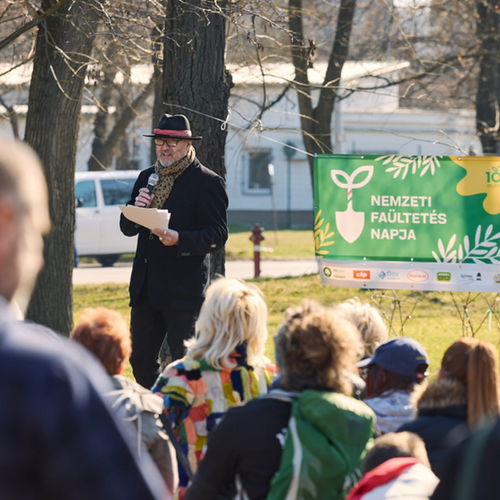
Népligeti Declaration – Delivered at the opening of the National Listening Day, March 1, 2026
Dear Friends! Esteemed Ladies and Gentlemen! Distant Parties and Governments, Companies and Churches!
We stand in the Népliget. In the grove of the people.
The name is not romantic, not decorative, but mandatory.
The grove is not the domain of power, not the domain of the market, not the domain of professional chambers, but of the community. And the community has a characteristic that politics often forgets:
it has not only a present tense but also a future tense.
However, the future is not built from program booklets, campaign slogans, or investment brochures, but from soil, water, and air.
And from people. From you, from us, dear Friends, and from decision-makers, those who provide funding sources.
In forty days, elections will be held in Hungary.
The political public sphere naturally concerns itself with itself. With astonishing noise, in which a trivial matter like the conditions of human existence is hardly audible.
For us, this silence usually remains. The silence of the forest, the silence of the fuss that comes with planting.
However, today I would not like us to remain completely silent!
In these weeks, when there are no distracting scare tactics or promises of pornography, fundamental issues are also being discussed. The fate of institutions, power structures, programs, and counter-programs are being weighed.
But there is one question that cannot be measured in cycles and cannot be separated from who will govern: the ecological baseline of the country.
And this is not a matter of mood. It is not an ideological question, even if it has developed in this direction in recent years. And it is not an emotional question either.
It is a physical question. An ecological question. A question of living conditions.
How much water the soil retains. How much the city cools down at night. How capable the landscape is of regenerating itself. How fertile the land remains.
In recent years, Hungary’s institutions have repeatedly come into conflict with power. When the autonomy of the University of Theatre and Film Arts was dismantled, students and teachers resisted. When CEU was pushed out of the country, there was protest. When the institutional structure of the Hungarian Academy of Sciences was restructured, academics raised their voices. When the centralization and dismantling of the education system took place, teachers took on the conflict, even though it was known in advance that their chances were slim. These protests were not successful because their strength did not add up, but they did indicate that there is institutional self-esteem, there is a moral reflex, and there is a limit.
PROFESSION
However, when the emergency decree – wrapped in what is now clearly an unjustifiable war rhetoric – known as the firewood decree, allowed for the accelerated logging of forests, including protected forests, treating the forest as an energy reserve, as a frost factory, as if it were not, in reality, a living, water-retaining, climate-regulating system, no statement of the weight and institutional strength of a national professional position was made that would have declared: the decision has ecological consequences that extend beyond a heating season.
No one stated that the forest is not merely a resource, but a national infrastructure. That cutting down the forest is not just an economic act, but a climate policy act. That the forest is the common wealth of society, and the ecological services of forests belong not to the owner, but to humanity, to the living conditions of those who reside here. The Kossuth Square was not overrun by outraged foresters concerned for their forests.
Unfortunately, the forest cannot protest. Therefore, it has guardians. The forestry companies, the professional chambers, the circle of institutional leaders, they are the ones who should have made the weight of the decision clear to the public.
Their silence in this case was not a technical detail, but a structural sign.
If in a system the logic of extraction is stronger than the ecological logic, then the structure is distorted. If the first reflex of professional institutions is not self-examination, but evasion of accountability, then there is a serious moral deficit. One cannot argue with the authority of centuries-old tradition in an era when the speed of climate change aligns not with historical examples, such as Maria Theresa, but with the laws of physics.
The merit of the retrospective past. But the past does not absolve from the responsibilities of the present.
GOVERNMENT
The government’s responsibility is no less.
The issue of the forest can be addressed with numbers. It can be emphasized in a superficial manner that the country’s forest cover has increased over the past decades, which is commendable at least compared to 1921.
One can counterbalance a controversial decision with communication.
But if conservation considerations are regularly subordinated to investment logic, if the destruction of habitats appears as a natural side effect during the preparation of major projects, then the priority has not changed. Environmental policy cannot be a subsystem within economic policy. Environmental policy is the foundation upon which economic policy is built. If this foundation is compromised, every other program remains partial.
COMPANIES
And one cannot ignore the role of global corporations either.
Today, there are companies whose budgets exceed those of states,
whose supply chains span continents,
whose energy consumption, raw material needs, and logistical systems have planetary effects.
These companies issue green reports,
make ESG commitments,
and set carbon neutrality dates.
However, institutionalized and consensus-based greenwashing is not climate policy. If ecological responsibility is a matter of communication strategy while the operational model remains essentially unchanged, then corporate power is accountable not only in economic terms but also in moral terms.
Planetary impact demands planetary responsibility.
Today, companies are no smaller players than states. Often, they are larger. And those who are larger have greater responsibilities.
CHURCHES
And we cannot overlook those institutions that have been tasked with caring for the soul, preserving the community, and universalizing love.
The churches are not economic actors. They are not authorities. They are not investors.
But they are defining authorities in the interpretation of the created world.
If Creation is not a backdrop, but a gift, if humanity is not a possessor, but a steward,
then the ecological crisis is not a matter of policy, but a question of conscience.
From the pulpit, in the congregation, in religious education classes, in community spaces, it must be stated:
the destruction of the created world is not a trivial consequence, but a moral deficit of humanity.
Religious communities – which have been shaping people’s moral horizons for centuries – have no lesser task today than to elevate the issue of creation protection to a level commensurate with the gravity of the situation.
Not as a political stance. But as a minimum of conscience.
The 10 Million Trees initiative is not a protest movement; it was not born as such. We plant and nurture. We were born from a realization: everyone is responsible.
No one can be left out.
And everyone has a role in preserving Creation, nature, ecological and biological unity and diversity. Not out of selflessness. In fact, based on the most selfish self-interest. After all, the crisis caused by warming and the narrowing of ecological and biodiversity threatens everyone living on Earth today.
Thus, we do not speak as a political counterpoint, but as citizens with the understanding that the current institutional and economic structure does not adequately address the ecological issue. And unfortunately, neither does politics. And if a turnaround occurs in Hungary’s life soon, it will be the most opportune moment to convey the indispensable and urgent requirement for environmentally conscious change.
If today the 10 Million Trees initiative and other environmentally conscious individuals and organizations were to write a government program, there would be no question that at the core of the concept would be the fundamental physical conditions of our existence, the issue of nature. From this would branch out health policy, education policy, agricultural and food policy, employment policy, and from this, the question of property rights, and the unavoidable rethinking of the principle of local governance. And from here, industrial policy as well, whether to base the national industrial strategy of the next decade on battery factories or on sectors that place less strain on our dwindling water resources.
What must be understood today, and this is the primary message of National Tree Planting Day, is that a tree is not a gardening gesture. A tree is water retention. A tree is soil protection. A tree is temperature regulation. A tree is climate infrastructure. If we, as citizens, plant a tree for every fellow citizen, it is not romanticism, but an acknowledgment that the country, at least with volunteers, is building a biological self-defense system.
We have started, and we ask everyone who has not yet done so, companies, institutions, professional organizations, parties, churches, to join us in this construction of a biological self-defense system.
National Tree Planting Day is not a charming spring event. It is not a family weekend. It is not a spectacular action. These are true as well. But mainly it is the declaration that the future is not automatic.
That the livability of the country is not a given, but a task.
That the issue of nature is not a sectoral question, but a national strategic foundation.
Anyone who oversees the issue of nature today, or even in the near future, must understand: silence is no longer professional neutrality, but a political stance. Those in decision-making positions must choose between the comfort of short-term gains and the responsibility of long-term consequences.
And yes: this must be stated, because the past decade and a half demands an assessment: those who have become unworthy of representing the cause of nature must make way for someone who is capable of doing so.
This is not an emotional outburst.
This is a structural consequence and requirement.
A country cannot afford to treat the issue of forests as a matter of loyalty or a side issue in communication. The issue of nature is also a matter of suitability.
The next government – regardless of which force shapes it – inherits not only an institutional system but also soil conditions, water balance, and temperature trends. These are not negotiable.
These cannot be postponed.
These are not subjects for interpretative debates.
These are physical parameters. If nature policy is not placed at the center of national strategic thinking, then every other decision will be temporary.
The Népliget is therefore not a backdrop today.
And not a background.
Not an event space.
But rather the place, a ceremonial venue, where we declare: the conditions for the future do not align with the current mode of operation. And if we do not change this, it will not be the political maps that will be redrawn first, but the boundaries of livability.
Ecological prerequisites take precedence over all other public policy considerations. Those who accept this have a place in this work. Those who do not must reckon with the fact that the consequences will be borne by their children and grandchildren, and they will have to face them, either literally or figuratively.
If all this is true – and unfortunately it is – then criticism is not enough. Accountability is not enough. It is not enough to articulate the sin of silence, the cowardice of cosmetic changes, the cynicism of greenwashing.
Then a structural change is necessary.
The country cannot afford for the issue of nature to remain a subsystem. It cannot afford for groundwater, shade, and biodiversity to be mere appendices in policy. And every child playing in a garden, every mother pushing her baby into the shade at the playground knows this. It is time for politicians and business leaders to understand it as well.
The country cannot afford for forests to be just a line item in the budget.
A new contract is needed.
A contract between humanity and nature – in which nature is not a tool, but a condition.
A contract between politics and the community – in which ecological stability is not a campaign topic, but a minimum requirement.
A contract between the profession and the public – in which professional knowledge does not remain silent when danger threatens.
A contract between the economy and future generations – in which profit does not precede livability.
This contract is not made on paper.
This contract is established through decisions, budget priorities, institutional appointments, and land use strategies.
The 10 Million Trees initiative is the beginning of this contract.
It is not a civil request.
Not a partnership offer.
And not a clever CSR opportunity.
But a statement: we will plant a tree for every Hungarian citizen, because the livability of the country demands it. We will organize tree planting events, because the people of the country desire the experience and testimony of such occasions in recognition and learning.
The consequences of planting, its beneficial effects, and the promotion of the idea and concept of tree planting ultimately affect every citizen and have a positive impact on every person’s life. Therefore, it is an important goal to involve everyone in this work sooner or later, even if only for a short time or at the level of thought. This includes the civil population, decision-makers, politicians, economic leaders, and those of faith and spirit.
Now, please allow me to read the 10 million trees initiative, the 10 points of the Népliget Declaration.
This declaration is a stable four-legged table: one leg for strategy, one for responsible economic operation, one for forest and water protection, and one for social embedding.
The Népliget Declaration – 10 points
I. STRATEGIC FOUNDATION
1. Nature policy should be an independent, prioritized area of national strategy; it should not be a subsystem within economic policy.
2. The national budget should include an independent, protected green infrastructure chapter that cannot be reallocated for investment purposes.
3. A mandatory, public, and accountable ecological balance must be prepared before every major investment.
II. RESPONSIBLE ECONOMIC OPERATION
4. An environmental impact fee based on real measurements should be introduced for construction and nature-damaging developments;
the revenue generated should be exclusively used for green infrastructure development in the affected municipalities, in cooperation with local governments and civil society.
III. FOREST AND WATER
5. Forests should be treated not as energy reserves but as climate infrastructure; ecological considerations should take precedence in forestry decisions.
6. The operations of state forestry enterprises should be subjected to regular, independent ecological audits.
7. The restoration of soil and water retention systems should be a national priority program, with particular attention to the Great Plain and drought-prone areas.
IV. SOCIAL EMBEDDING
8. To reduce the urban heat island effect, mandatory minimum regulations for trees and shading should be introduced for all new developments and in large cities.
9. Environmentally conscious civil organizations should be involved as institutional partners in the planning and maintenance of green infrastructure.
10. A tree should be planted for every eighth-grade and graduating student in the respective municipality, and long-term care for that tree should be ensured.
Iván András Bojár – 10 Million Trees, Founder
You can sign the petition here: https://szabad.ahang.hu/petitions/10-millio-fa-nepligeti-kialtvany-zold-ajanlat-a-mindenkori-kormanynak