Miyawaki Forests – Article by Balázs Zsolnai
In many cities around the world, we encounter a man-made, peculiar plant community known as the Miyawaki forest. A few years ago, the first one sprouted in Budapest, in Tabán, and since then, there are now precisely 12 such small forests in Budapest and Baja.
But where does this strangely named method originate from, and what is its essence?
In 2021, at the age of ninety-three, Akira Miyawaki, the botanist who created urban versions of forests based on his observations in the Far Eastern island nation, passed away. These forests, which exist in a large and perfect system, have been adapted into small urban versions operating on almost the same principles. The renowned botanist and plant ecologist is associated with more than thirteen hundred mini-forests in Japan alone.
In the latter half of the last century, Miyawaki observed that Japanese forests experienced many fires, and forests planted with economically valuable tree species were easily ignited and could not withstand the whims of the weather. He studied cultivated forests, their species composition, and began developing his urban mini-forest method based on native species, which could also be suitable for planting in large cities with polluted air.
The Miyawaki Method and Its Ecological Services
The Miyawaki forest is similar to bonsai, where we create large and majestic trees in apartment size. In the case of mini-forests, we recreate the likeness of a large forest on an urban scale. We replicate the diversity of a forest in a small area. Many trees in a small space purify the air in polluted cities, provide shade, humidify, and thus cool the environment, while offering a home and refuge for insects, songbirds, and mammals.
The method developed in the 1970s involves planting as many trees as possible in a given area within cities, typically in areas with poor soil quality.
Akira Miyawaki observed that if three or four saplings and shrubs are planted per square meter, the tree trunks remain thin, but the plants, competing for light, grow incredibly fast and produce a lot of oxygen.
The initial experiments proved successful, so some Japanese companies – such as Toyota – asked him to plant mini-forests on factory grounds. The method naturally worked here as well, and mini-forests began to grow in more and more places around the world, so today, Miyawaki’s name is associated with the planting of millions of urban trees using this method.
Planting
As with any method, there are certain parts that should be adhered to, showing respect to the creator. Deviations are possible, but in such cases, it should not be called a Miyawaki forest.
1. The soil composition must be examined, and either soil improvement or complete soil replacement must be carried out. This is essential, as it is one of the foundations for the healthy and rapid growth of trees, and in cities, the soil is generally unsuitable for such plantings.
2. The native tree and shrub species of the surrounding areas must be surveyed, and the species list should be compiled from these. Hardcore Miyawaki enthusiasts grow the future forest plants from seeds in pots at or near the site.
It is important to plant what is native to the area, not what we like.
3. The plants are planted in the prepared, organic-rich soil in a completely random manner, mimicking nature. Planting 2 or 3 trees and one shrub per square meter is necessary for the method to achieve its goals.
4. After planting and watering, one more important step follows: mulching the soil with organic material at least 10 cm thick. This protects the soil from drying out and provides nutrients to the soil during decomposition.
Straw is the most suitable for this, which in an urban environment is also the most entertaining conclusion to the work.
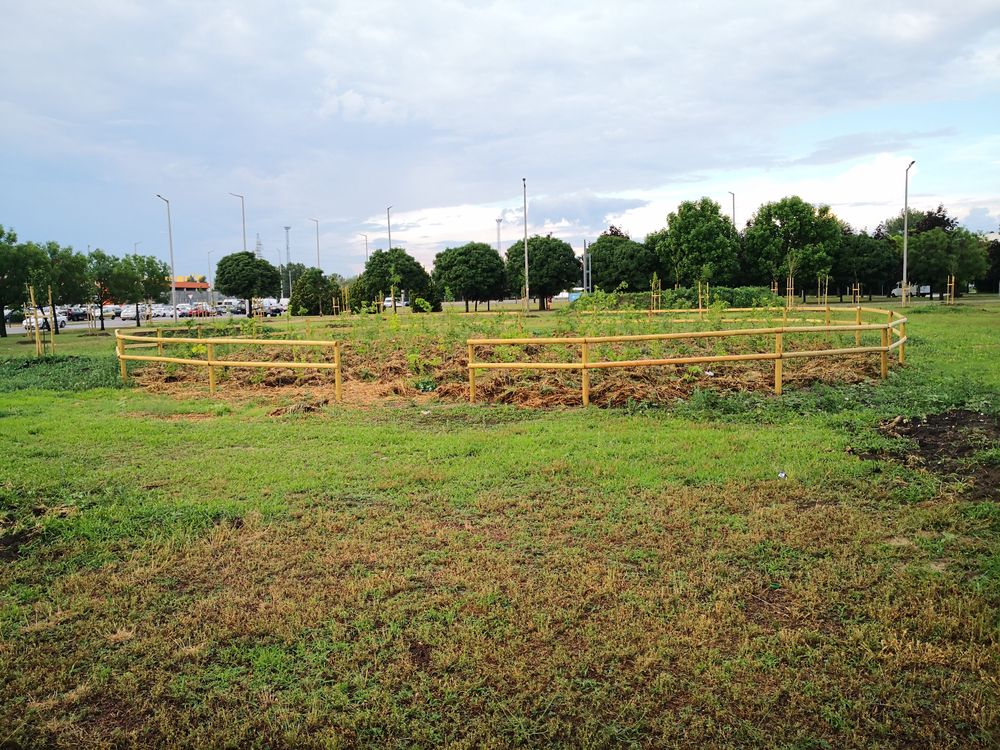
5. Around the finished forest, a low wooden fence can be built, benches can be placed, and a plaque about the creators of the forest and what an urban mini-forest is can be installed.
Maintenance
In the 2-3 years following planting, depending on the weather, it is advisable to water regularly during the summer and occasionally pull out the larger herbaceous undergrowth or wheat sprouted from the straw, which can be left there as nutrients.
Later, the forest becomes self-sustaining and a habitat.
Mini-forests around the world and at home
The Miyawaki method is popular in Asia and the United States.
In Europe, they are spreading mainly in France, Belgium, and the Netherlands, where they are breaking concrete and removing paving stones for mini-forest planting next to public spaces, school, and kindergarten yards, reducing the heat island effect while also providing educational activities for future generations.
Hungary’s first Miyawaki forest was planted in 2021 in the Tabán area of the capital. Experts from Főkert planted a total of one hundred and twenty saplings in an area of just forty square meters.
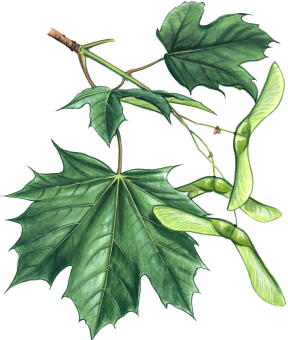
Among the planted species were wild service tree, hornbeam, wild pear, wych elm, sessile oak, spindle, single-seed hawthorn, as well as field and Norway maple. These species are typically native to the slopes of the Buda hills, thus imitating the deciduous forest community of the limestone-soiled, mid-mountain region.
The marketing of the first mini-forest proved so successful that small mini-forests began to sprout in several districts of Budapest and in a provincial town, Baja.
These are as follows:
2. Baja Miyawaki 120 m2 400 plants
3. Soroksár Auchan 200 m2 600 plants
4. Boráros Square Miyawaki 60 m2 200 plants
5. Budafok Miyawaki 55 m2 200 plants.
6. Lenhossék Street Miyawaki 80 m2 240 plants
7. Zsigmond Square Miyawaki 13 m2, 52 pcs
8. 2. Baja Miyawaki 120 m2, 400 plants
9. Andor Street Miyawaki, 60 m2, 240 plants
10. Rákoskert Miyawaki 260 m2 1300 plants
11. Erdélyi János Square Miyawaki 30 m2 240 plants
12. Rákóczi Miyawaki 70 m2 280 plants
Balázs Zsolnai
certified horticultural engineer, plant doctor
+36705087070